
Latest Blog Posts
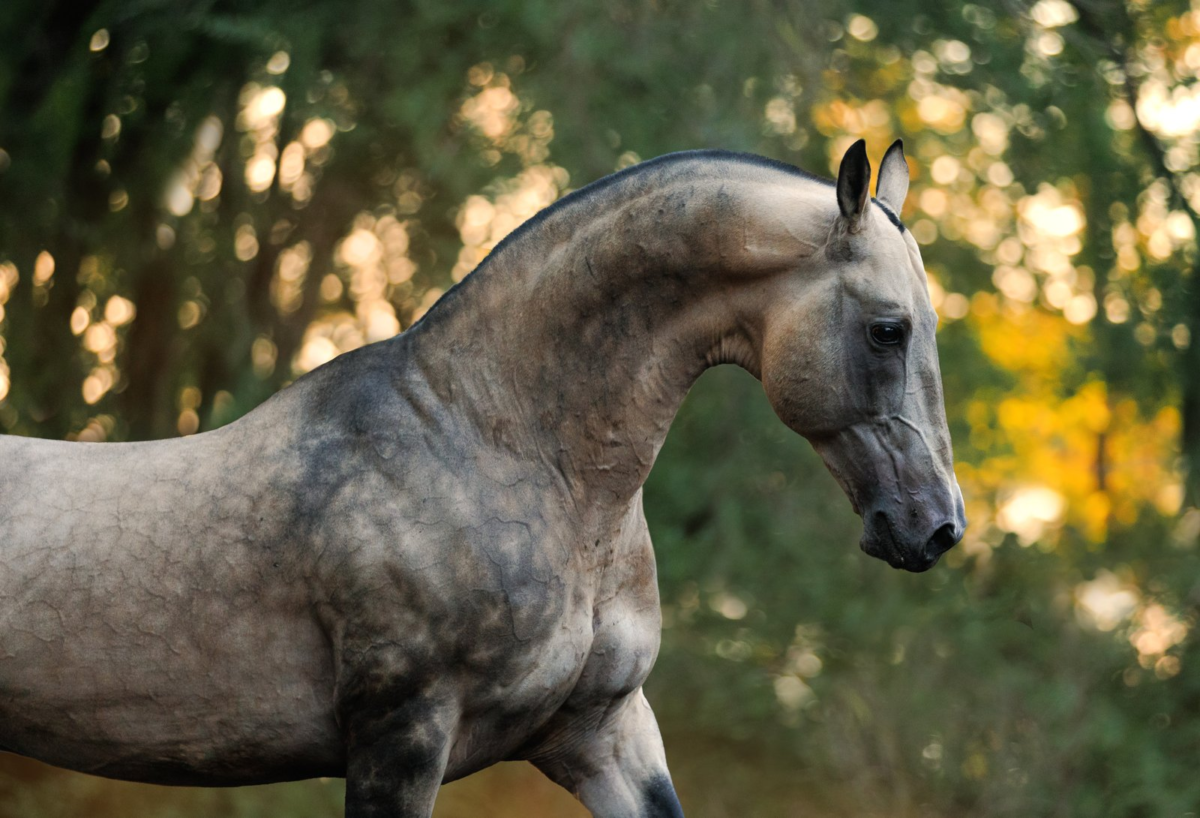
Ahal-Teke Horse — A Perfect Example of Beauty
The Golden Horse of Turkmenistan Meets Europe
There are beautiful horses in every corner of the world.
Some are admired for their strength. Others for their speed, elegance, athleticism or noble character. But there is one horse whose appearance seems almost unreal….
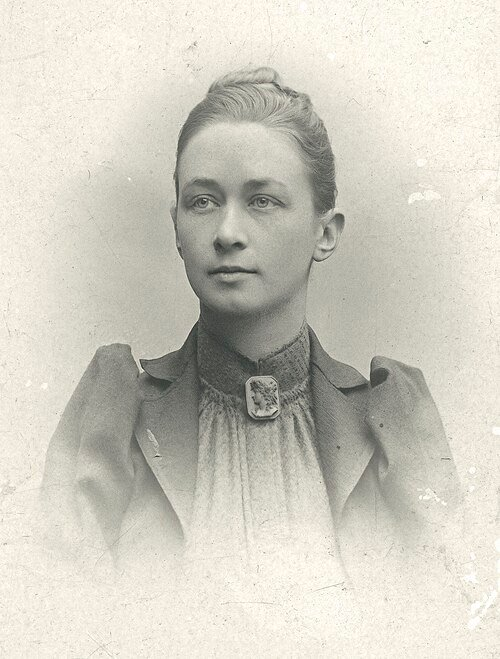
The Woman Who Invented Abstract Art and Kept It Secret for 20 Years
Swedish artist named Hilma af Klint (1862–1944) had already beaten them to it. Working in near-total secrecy, af Klint created massive, vibrant abstract paintings as early as 1906.
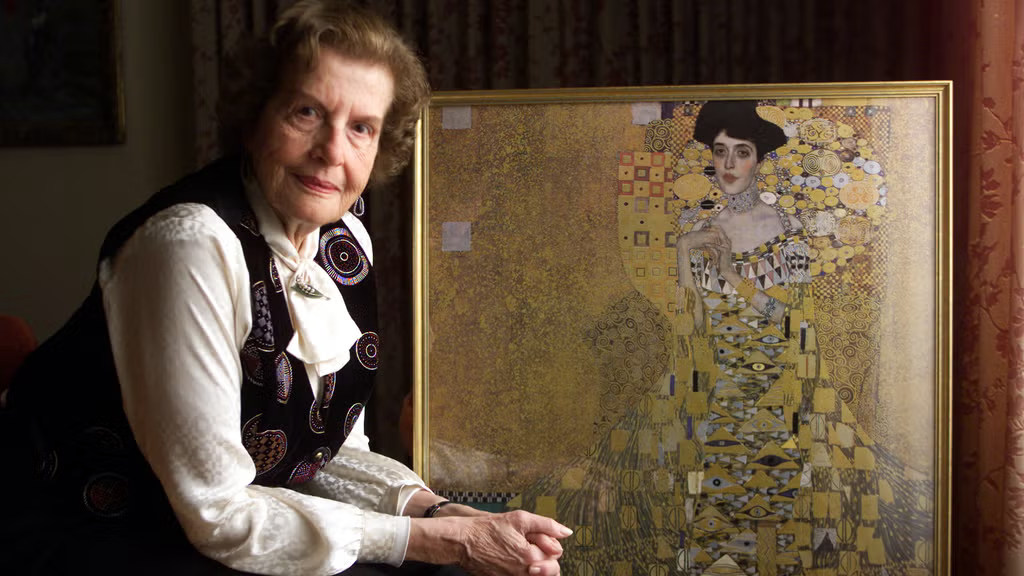
"Woman in Gold"
“Woman in Gold” is a famous portrait painted by Austrian Symbolist artist Gustav Klimt. The painting is formally titled “Portrait of Adele Bloch-Bauer I”. It was completed in 1907 and is widely regarded as one of Klimt’s masterpieces.
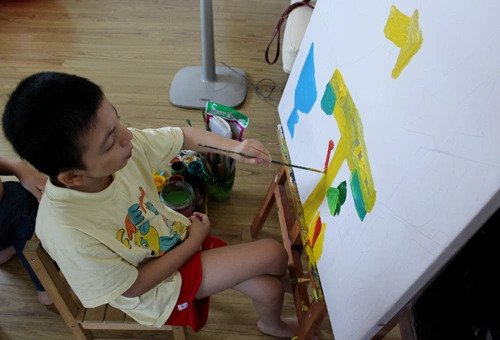
The Silent Symphony of Colors:
In a world bustling with noise and chatter, where words often take center stage, there exists a young virtuoso who has mastered the art of expressing himself without uttering a single word. Meet Ha Dinh Chi, affectionately known as his soul.
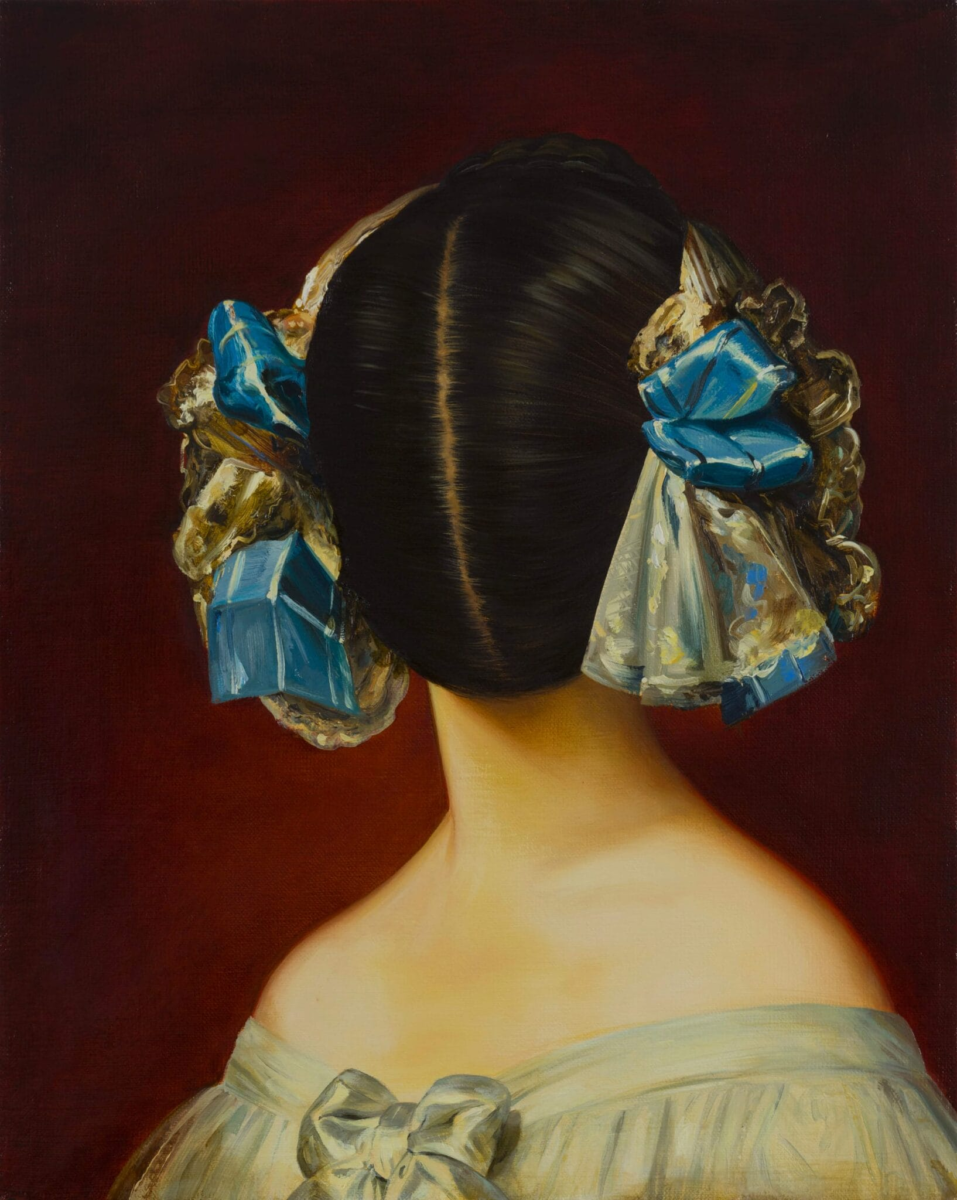
"Head-Turning" Historical Portraits by Ewa Juszkiewicz
“Woman in Gold” is a famous portrait painted by Austrian Symbolist artist Gustav Klimt. The painting is formally titled “Portrait of Adele Bloch-Bauer I”. It was completed in 1907 and is widely regarded as one of Klimt’s masterpieces.
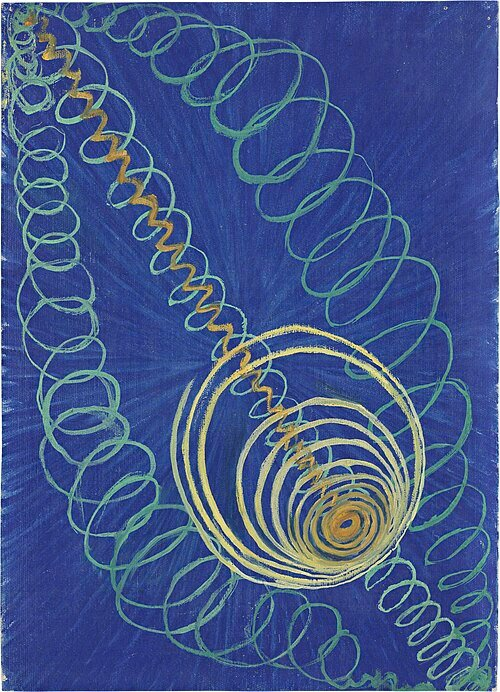
The Woman Who Invented Abstract Art and Kept It Secret for 20 Years
Long before Wassily Kandinsky, Piet Mondrian, or Kazimir Malevich claimed credit for launching abstract art in the 1910s, a Swedish artist named Hilma af Klint (1862–1944) had already beaten them to it. Working in near-total secrecy, af Klint created massive, vibrant abstract paintings as early as 1906. Yet, by her own command, these ground-breaking masterpieces remained hidden from the world until decades after her death.
From Academic Realism to Seances
Born in Solna, Sweden, af Klint was among the first generation of women to study at the Royal Swedish Academy of Fine Arts in Stockholm. She graduated with honors in 1887 and built a successful career painting conventional landscapes, botanical studies, and portraits.
However, a parallel world called to her. Following the early death of her younger sister, af Klint turned toward Spiritualism, Theosophy, and Rosicrucianism. In 1896, she formed a secret collective with four other women artists known as “The Five” (De Fem). Meeting weekly, they conducted seances, practiced automatic drawing, and recorded messages from higher spiritual beings they called the “High Masters.”
Paintings for the Temple: A Radical Vision
In 1906, at age 44, af Klint began her defining project: Paintings for the Temple. Commissioned—as she believed—by a spirit named Amaliel, this monumental body of work comprised 193 canvases created between 1906 and 1915.
Unlike her conventional studio portraits, these works featured biomorphic shapes, bold geometric spirals, pastel color palettes, and cryptic symbols. Her famous series The Ten Largest measured over 10 feet tall, depicting the stages of human life from childhood to old age in sweeping, energetic forms.
Key themes in her abstract universe included:
Duality and Unity: Balancing male and female, light and dark, spirit and matter.
Scientific Curiosity: Translating invisible forces—like atomic particles, electromagnetic waves, and botany—into visual diagrams.
Color Symbolism: Using blue to represent the feminine/spiritual, yellow for the masculine/intellectual, and green for harmony.
Hidden from a World Unready
Af Klint understood that the conservative art world of the early 20th century was not ready to comprehend her work. In 1908, when Anthroposophy founder Rudolf Steiner visited her studio, he praised the paintings but warned that contemporary audiences wouldn’t understand them for another 50 years.
Taking this advice to heart, af Klint stipulated in her will that her abstract collection—over 1,200 paintings and 124 notebooks—must not be shown publicly until at least 20 years after her death.
She died in 1944 following a streetcar accident, leaving her nephew, Erik af Klint, as the custodian of a massive secret archive.
Rewriting Art History
When her work finally debuted at the Los Angeles County Museum of Art in 1986, it sent shockwaves through the art establishment. By the time the Guggenheim Museum hosted her retrospective Hilma af Klint: Paintings for the Future in 2018–2019, it became the most visited exhibition in the museum’s 60-year history.
Hilma af Klint didn’t just paint to innovate art; she painted to make the invisible visible. Today, history has finally caught up to her vision, rightfully recognizing her as the true pioneer of modern abstraction.
Ahal-Teke Horse — A Perfect Example of Beauty
The Golden Horse of Turkmenistan Meets Europe
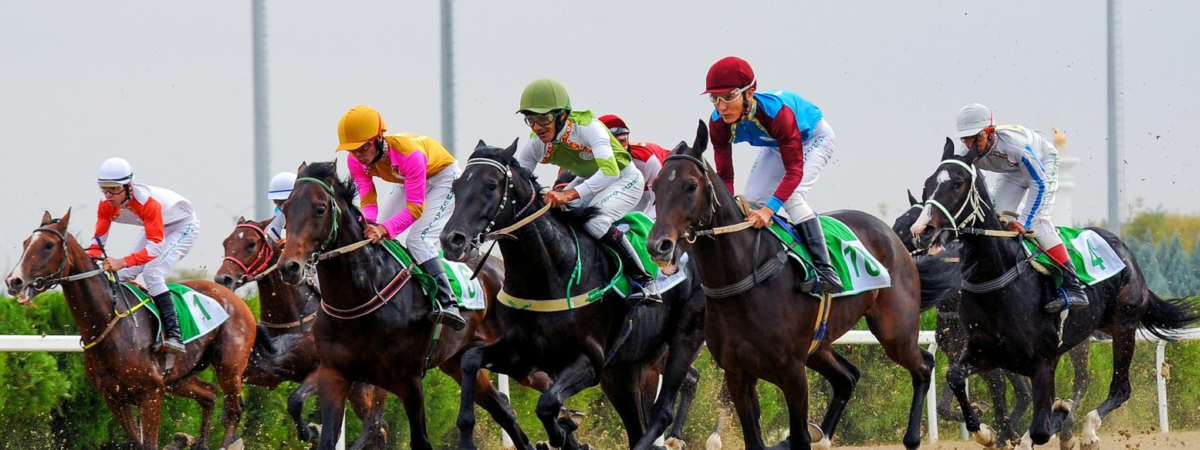
Photo Source: https://www.turkmenatlary.gov.tm
There are beautiful horses in every corner of the world.
Some are admired for their strength. Others for their speed, elegance, athleticism or noble character.
But there is one horse whose appearance seems almost unreal — a horse with a distinctive metallic shine, extraordinary grace, refined proportions and a history deeply intertwined with an entire culture.
The Ahal-Teke horse.
Known around the world as the “golden” or “heavenly” horse, the Ahal-Teke is one of the most recognizable horse breeds associated with Central Asia. Its homeland is Turkmenistan, where the horse is far more than an animal or a sporting partner. It is a symbol of beauty, loyalty, courage, freedom, and national identity.
For generations, the Turkmen people have regarded the horse as a trusted companion and as one of the greatest treasures passed from one generation to another. Today, that relationship is reaching an international audience once again.
And in September 2026, something particularly significant will happen:
The Ahal-Teke horse will take center stage in Europe.
“Melebatyr”, by Tatyana Nemova, Equestrian Photographer, Russia
A Horse Like No Other
The first impression of an Ahal-Teke is often its unusual elegance.
The long, refined neck.
The expressive eyes.
The fine head.
The powerful yet slender body.
The long, graceful legs.
The proud posture.
And then there is the coat.
Under sunlight, some Ahal-Teke horses appear almost metallic, producing shades of gold, bronze, champagne and copper. This remarkable sheen is one of the characteristics that has made the breed famous around the world.
But beauty is only part of the story.
Ahal-Teke horses are also celebrated for their speed, endurance, agility, intelligence and loyalty. Their physical characteristics were shaped over generations in the demanding environment of Turkmenistan, contributing to a horse capable of enduring heat, distance and difficult terrain.
This combination of beauty and performance is what makes the Ahal-Teke so fascinating.
It is not simply a beautiful horse.
It is beauty with purpose.
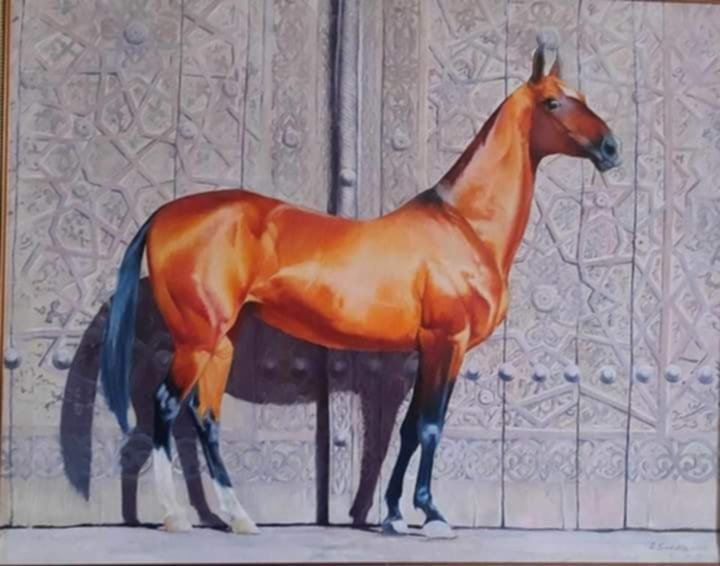
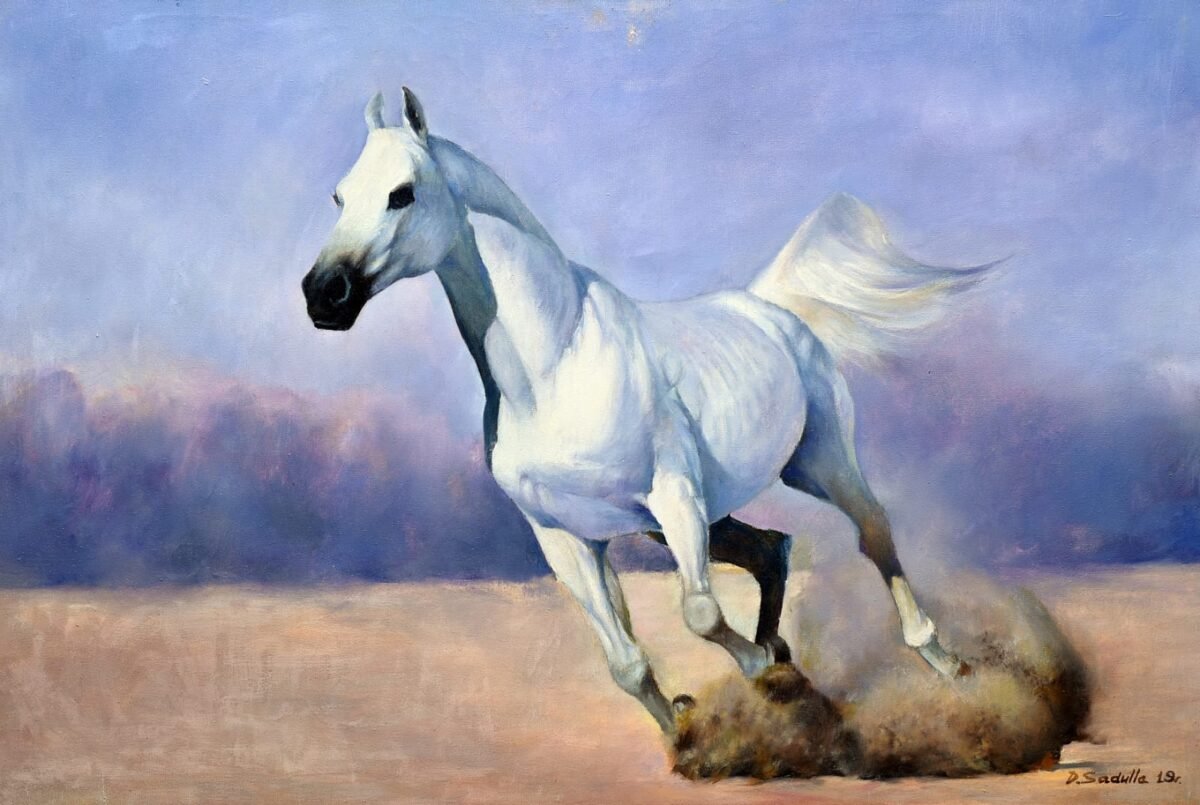
Artworks by Sadulla Dawletow, Turkmenistan
The Horse and the Soul of Turkmen Culture
To understand the Ahal-Teke, one must look beyond the horse itself.
In Turkmen culture, the horse has traditionally held an extraordinary place. Stories, legends, poetry, music, art, and craftsmanship have all carried the image of the beloved Turkmen steed through generations.
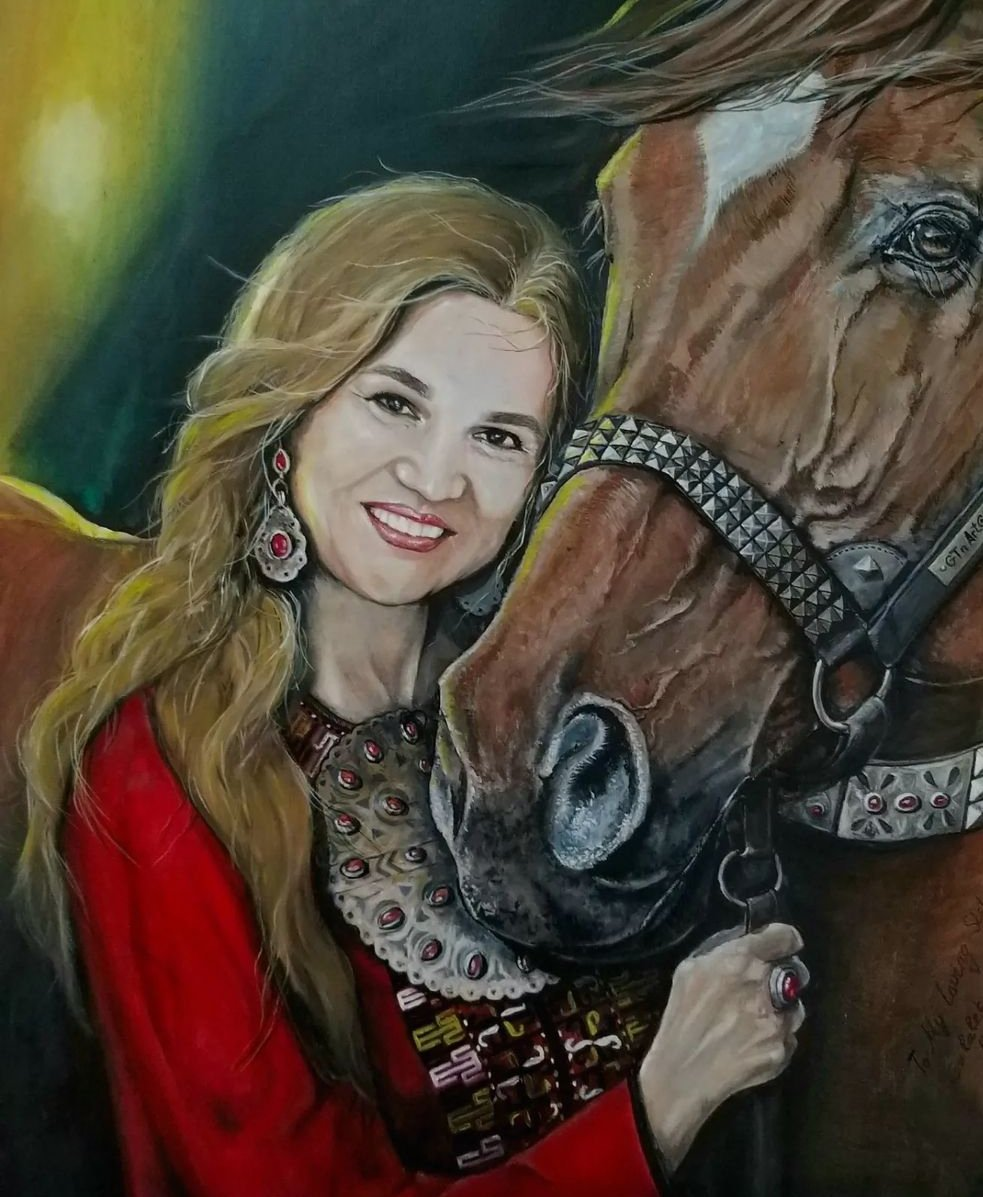
“Beauties of Turkmenistan”,
by Gulalek Esenova (GTnArt), Turkmenistan-UAE
The horse became a companion in travel, work, warfare and celebration — but also a source of artistic inspiration.
Traditional horse decoration is itself an art.
Turkmen craftsmen have historically created elaborate ornaments, embroidered saddle coverings, jewelry and decorative elements for their horses. Precious metals, textiles and intricate patterns transformed the horse into something approaching a living work of art.
This tradition is not simply about decoration.
It represents the relationship between human creativity, craftsmanship and the horse.
The cultural significance of Ahal-Teke horse breeding and traditional horse decoration was recognized internationally when the element “Ahal-Teke horse breeding art and traditions of horse decoration” was inscribed on UNESCO’s Representative List of the Intangible Cultural Heritage of Humanity in 2024.
This recognition is important because the heritage is not only the horse.
It is the knowledge, skills, traditions and artistic practices surrounding the horse.
“Golden Beauty”, Artwork by Jelena Martinovic, Croatia
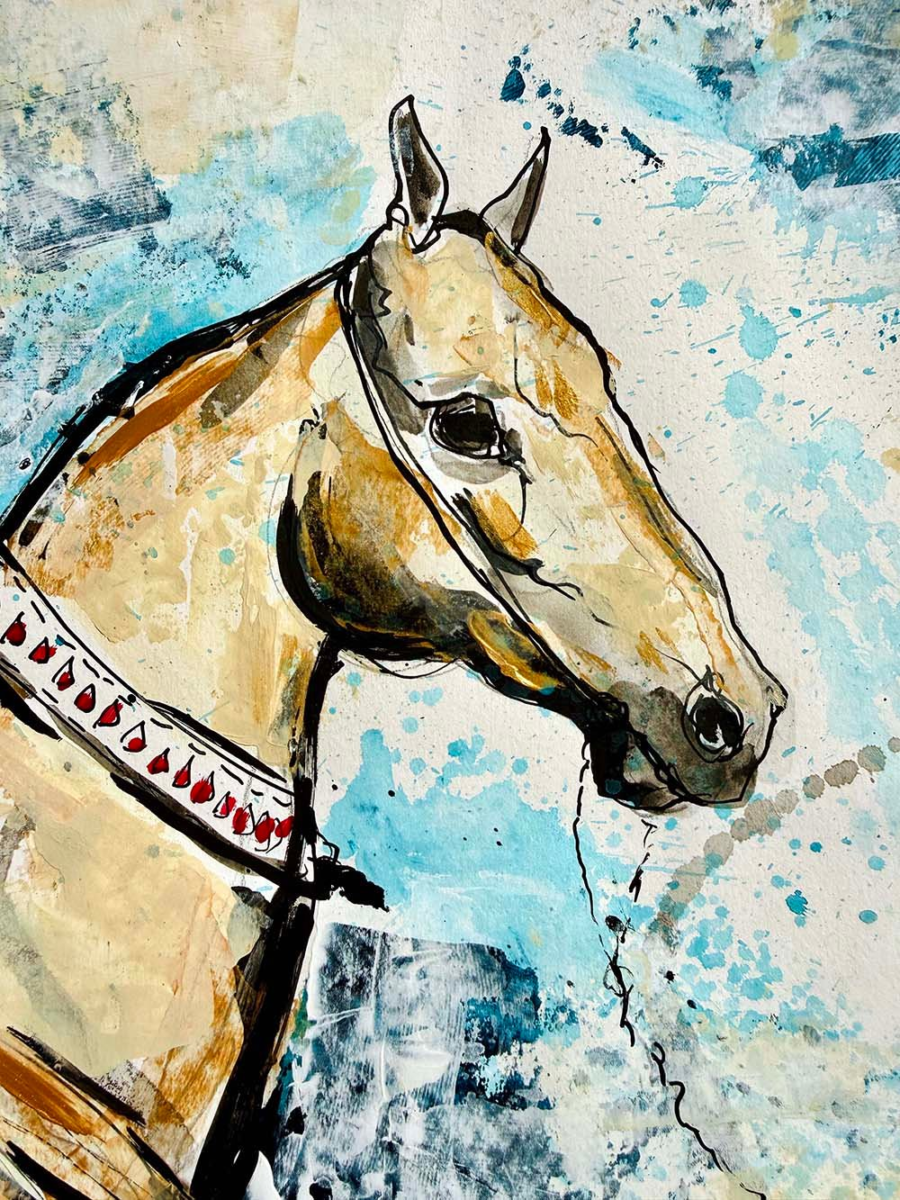
From the Ancient Turkmen Land to the World
The history of the Ahal-Teke reaches deep into the past.
Turkmenistan’s archaeological heritage contains evidence connected with ancient horse domestication and breeding traditions, while historical sources from different civilizations describe swift horses associated with the region. Modern Turkmen sources describe the Ahal-Teke as a breed whose development has taken place over thousands of years.
Over centuries, generations of horse breeders — known traditionally as seyis — worked to preserve desirable qualities and bloodlines.
The result is a horse with a remarkable combination of refinement and resilience.
One of the most famous demonstrations of the breed’s endurance occurred in 1935, when Turkmen horsemen travelled from Ashgabat to Moscow. The journey lasted 84 days and included crossing the Karakum Desert. The horses successfully completed the expedition, with the horse Tarlan becoming particularly celebrated.
The story illustrates something essential about the Ahal-Teke:
its elegance has never meant fragility.
Behind the shining coat is an athlete.
The Ahal-Teke Enters Europe
September 4–6, 2026 — Kronenberg, Netherlands
In September 2026, the story of the Ahal-Teke will reach a new European chapter.
From 4 to 6 September 2026, the Peelbergen Equestrian Centre in Kronenberg, the Netherlands, will host the World Championship in equestrian sports together with an international Ahal-Teke horse beauty contest.
Turkmenistan’s official announcements describe the event as a first-of-its-kind event in Europe, creating a major opportunity for European audiences to encounter the Ahal-Teke horse and Turkmen equestrian heritage more closely.
And this will be much more than a horse competition.
The program is expected to bring together:
Equestrian competitions
An international Ahal-Teke horse beauty contest
An international scientific and practical conference
An exhibition of Turkmen culture, crafts and traditions
Performances by the Galkynyş National Equestrian Games Group
Artists from the State Circus of Turkmenistan
The event is being organized by the Türkmen Atlary State Association together with the European Association of Akhal-Teke Horses.
For European audiences, this is a rare opportunity to see not only the horses themselves, but also the culture that has surrounded them for centuries.
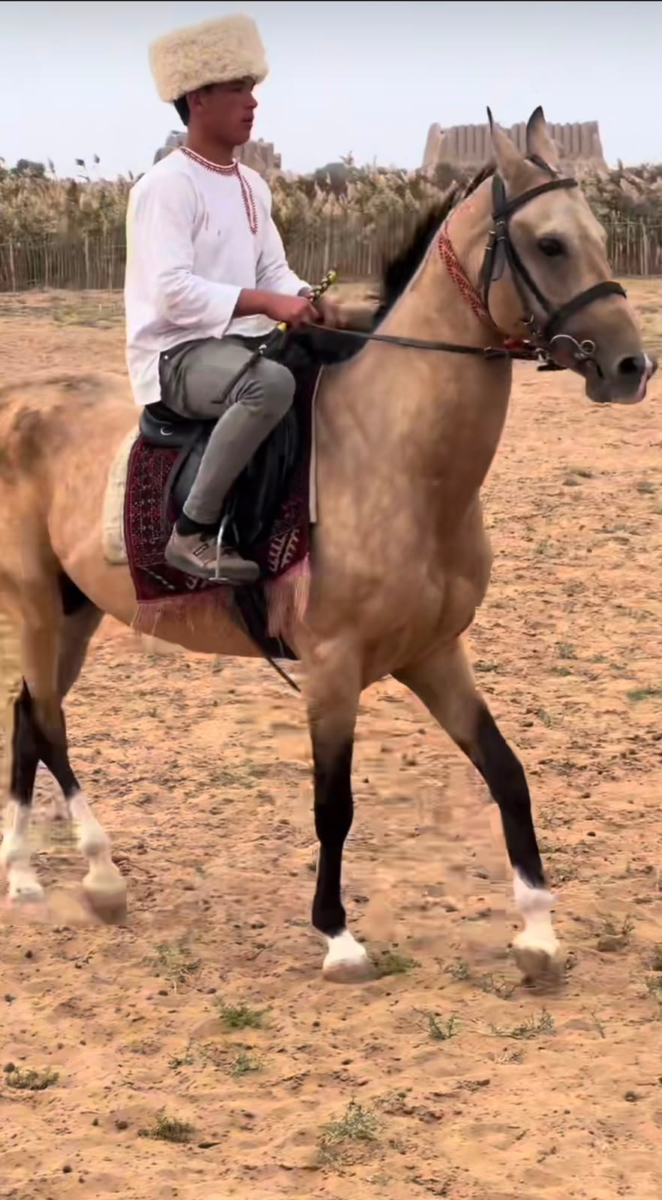
Photography by Journalist Bahar Hpdjamuhammedova, Turkmenistan
Beauty Beyond the Horse
Perhaps the most fascinating aspect of the September event is that the Ahal-Teke will be celebrated not only through sport, but also through art and culture.
The beauty of the horse has inspired painters, sculptors, photographers, jewelry designers and carpet artists for generations.
The international art competition “Ahal-Teke Horse — A Perfect Example of Beauty” was created to artistically interpret this extraordinary subject through different forms of visual expression, including painting, sculpture, jewelry, carpet art and photography.
This creates another bridge between the horse and human creativity.
An artist sees the curve of its neck.
A sculptor sees movement.
A photographer sees light reflected from its coat.
A jeweler sees the possibility of translating its elegance into precious form.
A carpet artist sees centuries of cultural memory.
And each artist tells a different part of the same story.
The Ahal-Teke becomes not only a subject of art, but a living source of inspiration.
A Cultural Bridge Between Turkmenistan and Europe
The significance of the Netherlands event extends beyond horses.
It creates an opportunity for cultural dialogue.
Turkmenistan is bringing to Europe a part of its heritage that cannot be fully understood through photographs alone. The horse, its decoration, its traditions, its music, its craftsmanship and the stories surrounding it all belong to a larger cultural landscape.
The event has also been presented as an opportunity to strengthen friendship, mutual understanding and humanitarian connections between Turkmenistan and the Netherlands.
In this sense, the Ahal-Teke becomes something even more powerful:
a cultural ambassador.
It carries the history of Turkmenistan beyond its borders and invites the world to discover the people, creativity and traditions behind the legendary horse.
From Turkmenistan to the World
September 2026 marks an exciting moment in the international story of the Ahal-Teke.
For the first time, a major event dedicated to the breed and its beauty is being presented on this scale in Europe.
The setting is the Netherlands.
The subject is a horse born from the ancient lands of Turkmenistan.
But the message is universal.
Beauty belongs to everyone.
Culture connects people.
Art crosses borders.
And sometimes, a single horse can tell the story of an entire nation.
From the golden landscapes of Turkmenistan to the equestrian grounds of Kronenberg, the Ahal-Teke continues its journey across the world — carrying with it history, artistry, strength and the unmistakable spirit of the Turkmen people.
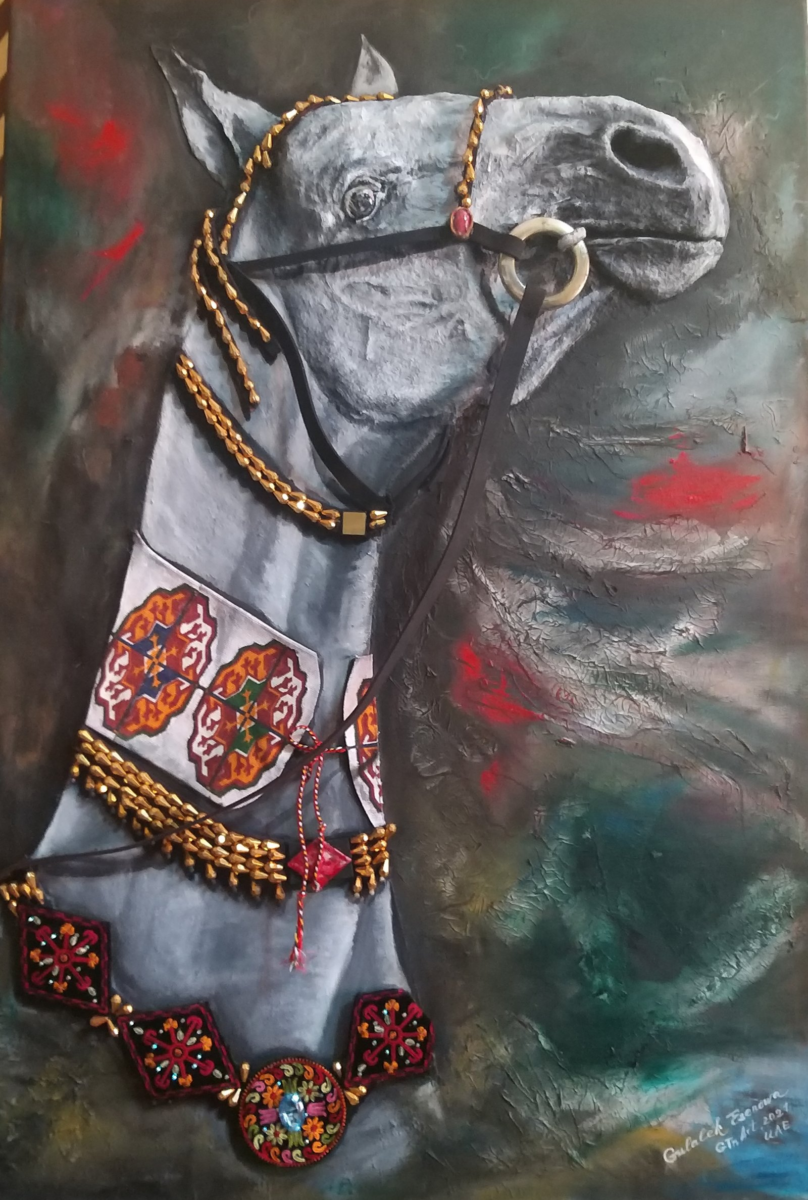
“AK KHAN”, 3D Sculptural Artwork by
Gulalek Esenova (GTnArt), Turkmenistan-UAE
Why “A Perfect Example of Beauty”?
Beauty is difficult to define.
It is not always symmetry.
It is not always perfection.
Sometimes beauty comes from character — from the combination of history, strength, movement and spirit.
Perhaps that is why the Ahal-Teke has fascinated people for so long.
Its beauty is immediately visible, but its deeper meaning takes time to discover.
Look at an Ahal-Teke standing beneath the sunlight and you may first notice the golden shimmer.
Watch it move and you see elegance.
Learn its history and you discover endurance.
Discover Turkmen horse culture and you encounter craftsmanship, tradition and devotion.
And finally, you begin to understand why generations of Turkmen people have called these horses their “wings.”
From Turkmenistan to the World
September 2026 marks an exciting moment in the international story of the Ahal-Teke.
For the first time, a major event dedicated to the breed and its beauty is being presented on this scale in Europe.
The setting is the Netherlands.
The subject is a horse born from the ancient lands of Turkmenistan.
But the message is universal.
Beauty belongs to everyone.
Culture connects people.
Art crosses borders.
And sometimes, a single horse can tell the story of an entire nation.
From the golden landscapes of Turkmenistan to the equestrian grounds of Kronenberg, the Ahal-Teke continues its journey across the world — carrying with it history, artistry, strength and the unmistakable spirit of the Turkmen people.
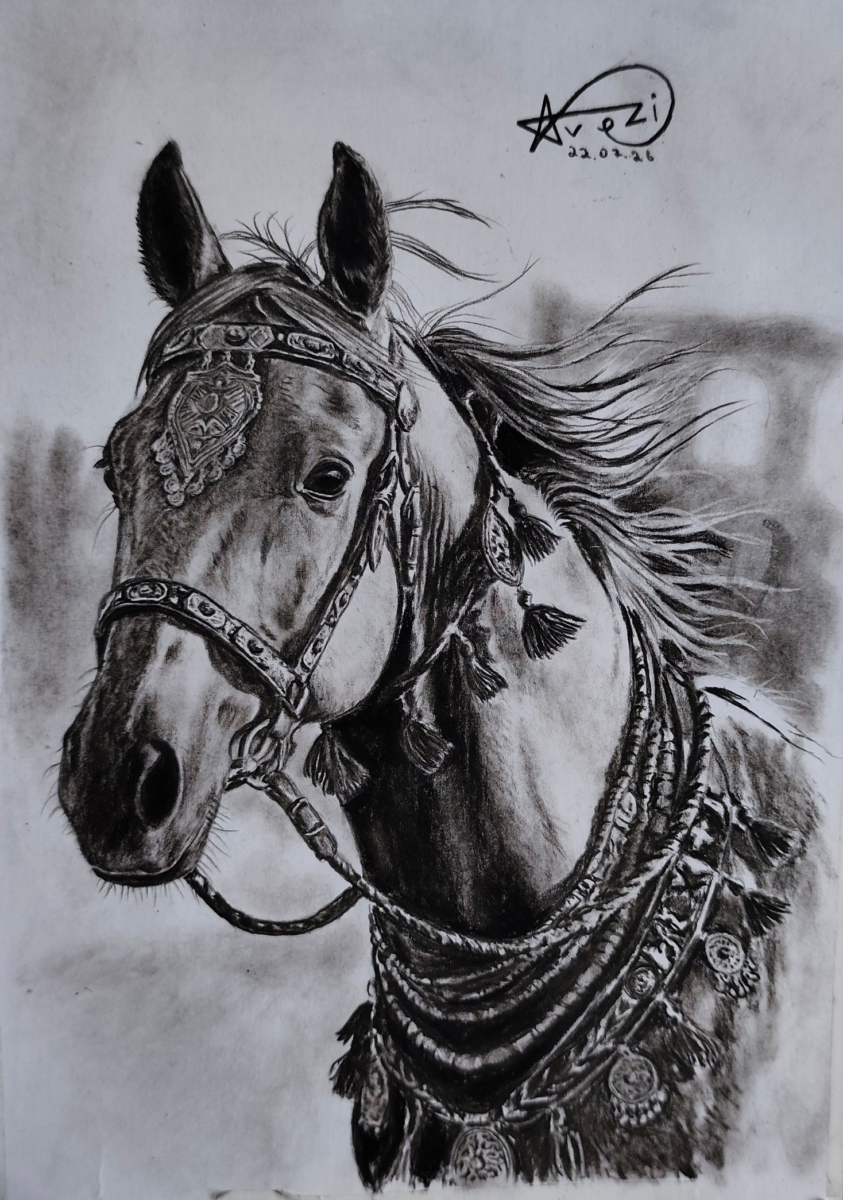
Artwork by Saparow Ovez, Turkmenistan
Ahal-Teke Horse — A Perfect Example of Beauty.
A living heritage.
A masterpiece of nature.
A symbol of Turkmenistan.
And now, a new chapter in Europe.
The World Championship in equestrian sports and the international Ahal-Teke horse beauty contest are scheduled for 4–6 September 2026 at the Peelbergen Equestrian Centre in Kronenberg, Netherlands.
For Art. For Culture. For Heritage. For the world.
“As an Artist and Cultural Representative of Turkmenistan, I feel especially proud to see the Ahal-Teke Horse presented to a European audience through both equestrian sport and art…”
Prepared by Gulalek Esenova (GTnArt)
Artist • Cultural Representative of Turkmenistan • International Art & Cultural Ambassador
Founder of GTnArtGallery
Founder & Creator of 3D Optic Paper Art
Promoting Turkmen Art, Culture & Heritage on the International Stage
08.2026. UAE
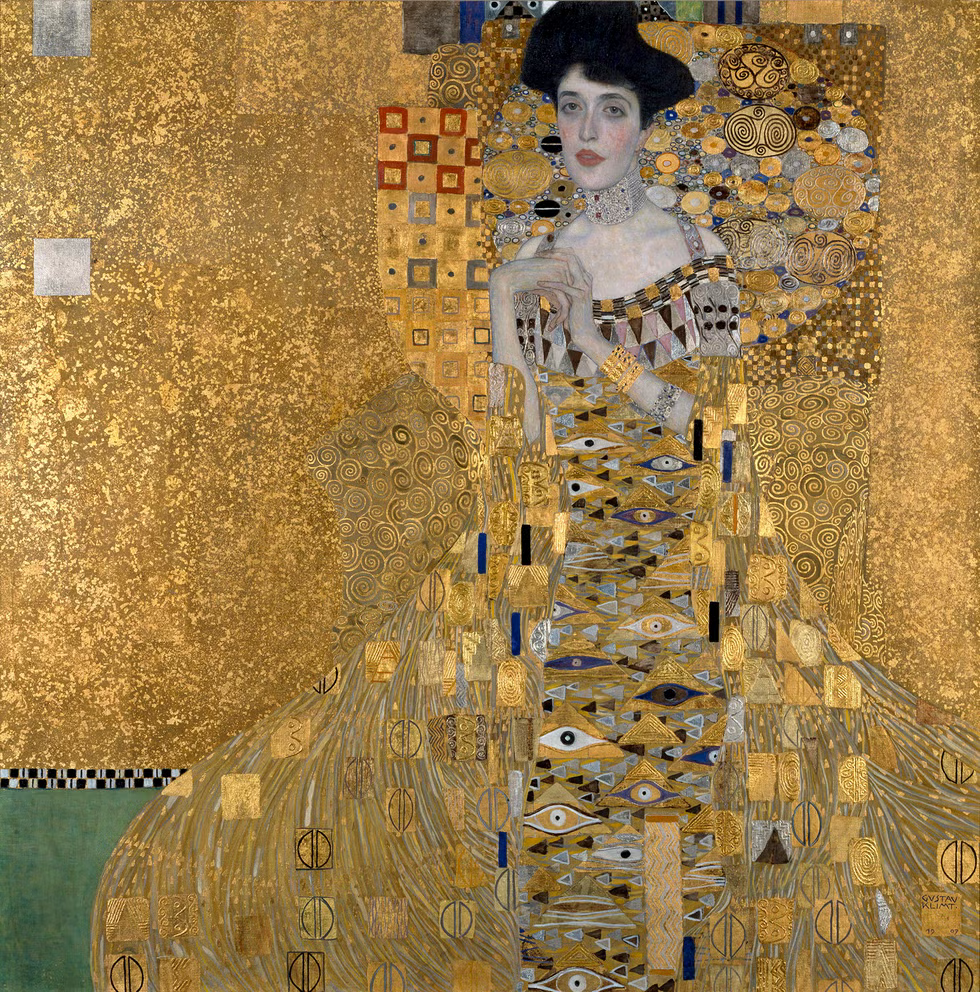

"Woman in Gold"
“Woman in Gold” is a famous portrait painted by Austrian Symbolist artist Gustav Klimt. The painting is formally titled “Portrait of Adele Bloch-Bauer I”. It was completed in 1907 and is widely regarded as one of Klimt’s masterpieces.
The subject of the painting, Adele Bloch-Bauer, was a prominent and wealthy Viennese woman who was a close friend and patron of Gustav Klimt. The portrait is known for its intricate and highly decorative style, which is characteristic of Klimt’s work during his “Golden Phase.”
The painting features Adele Bloch-Bauer in an opulent and luxurious robe, surrounded by intricate patterns and gold leaf. The use of gold leaf is a signature element of Klimt’s style during this period, and it contributes to the painting’s luminous and ethereal quality.
“Woman in Gold” holds historical significance beyond its artistic value. In 2006, the painting gained international attention due to a restitution case.
The painting had been looted by the Nazis during World War II from Adele Bloch-Bauer’s family and later became part of Austria’s national art collection. Adele’s niece, Maria Altmann, fought a legal battle to reclaim the painting, which was eventually restituted to her. The legal battle was the subject of the 2015 film “Woman in Gold,” starring Helen Mirren as Maria Altmann.
The painting itself was eventually sold in a private transaction to Ronald Lauder, the founder of the Neue Galerie in New York City, for a reported price of $135 million in 2006. It is now on display at the Neue Galerie, where visitors can appreciate this iconic work of art.
In summary, “Woman in Gold” is a renowned portrait painted by Gustav Klimt, known for its intricate decorative style, use of gold leaf, and historical significance related to Nazi looting during World War II.


The Silent Symphony of Colors: Unveiling the Artistic Passion of Ha Dinh Chi
In a world bustling with noise and chatter, where words often take center stage, there exists a young virtuoso who has mastered the art of expressing himself without uttering a single word. Meet Ha Dinh Chi, affectionately known as Nem, a remarkable young artist whose canvas is a testament to the vibrant symphony of colors that reside within his soul.
Nem’s journey is a testament to the power of art to transcend the boundaries of communication. While his spoken words may be scarce, his artwork speaks volumes, conveying emotions, stories, and dreams that have found their voice through his skilled strokes and masterful use of colors.
Nem’s quiet demeanor belies a world of creativity and imagination that comes to life on his canvas. Each brushstroke is a step into a realm where colors dance and blend, giving birth to breathtaking landscapes, intricate portraits, and abstract visions that invite viewers to contemplate the depths of his artistic vision.
His art isn’t just a hobby; it’s a passion that has become an inseparable part of his identity. With a profound understanding of colors and an uncanny ability to evoke emotions through his art, Nem’s work resonates with those fortunate enough to experience it. His pieces are a kaleidoscope of feelings, a silent language that communicates the universal emotions that connect us all.
Nem’s artistic journey is a testament to the therapeutic power of creativity. In his world, brushes are not mere tools; they are extensions of his thoughts, vehicles that carry him into a realm of tranquility and self-expression. Art has become his sanctuary, a space where he can make his voice heard in a way that feels comfortable and genuine.
As we marvel at the intricate details and vivid hues of Nem’s creations, we are reminded that art has the ability to bridge gaps, to dissolve barriers, and to unite hearts. In a world often filled with noise and chaos, Nem’s art offers a gentle reminder to pause, to appreciate the beauty that can emerge from stillness, and to recognize the extraordinary talents that can blossom even in the quietest corners of existence.
So, the next time you find yourself standing before one of Ha Dinh Chi’s mesmerizing works of art, take a moment to listen—to the stories he tells through his colors, to the emotions he conveys through his brushstrokes, and to the symphony of creativity that emanates from his silent world. In doing so, you’ll discover a world that is anything but dull, a world that vibrates with the richness of imagination and the profound magic of artistic passion.
gtnartgallery.com
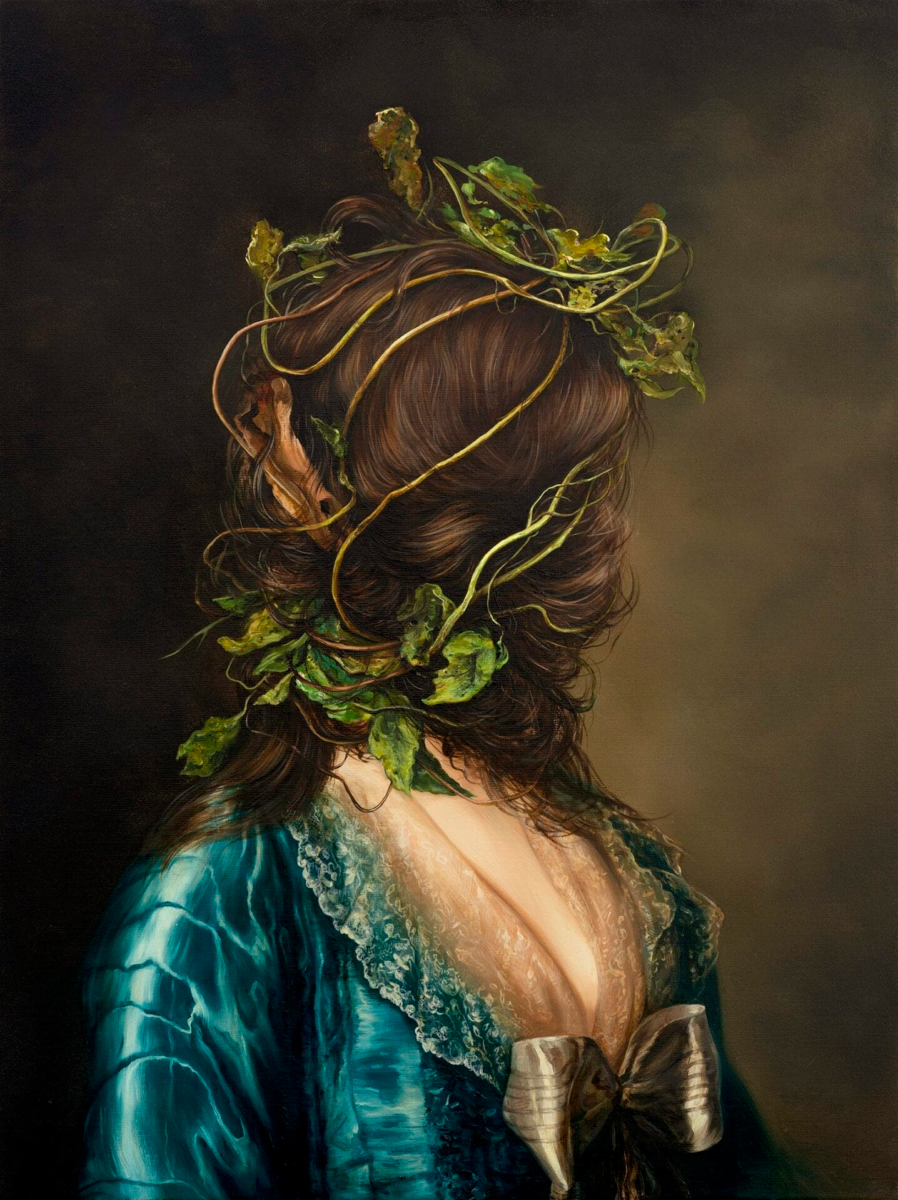
"Head-Turning" Historical Portraits by Ewa Juszkiewicz
Ewa Juszkiewicz subverts the traditional notion of female portrait sitters as passive, simple subjects in her subtly unusual oil paintings. The artist constructs each painted portrait using familiar tropes from European art history, sometimes even citing specific paintings as inspiration. Female subjects with smooth, pale skin and luxurious apparel are placed in front of abstract or generically bucolic settings, sometimes with a “gender-appropriate” item in hand, like a paint brush, small book, or feather.
But in place of the beautiful face a viewer would expect in the center of these pleasant trappings, Juszkiewicz has turned the subject’s head 180 degrees to show an elaborate hairstyle, or filled the face with unruly plants or ribbons. A statement on the artist’s website explains, “Through the deconstruction of historical portraits, she undermines their constant, indisputable character and tries to influence the way we perceive them. Juszkiewicz experiments with the form of the female figure and face, balancing on the border between what is human and inhuman.”
The artist lives and works in Warsaw, Poland. She is represented by Galerie Rolando Anselmi in Berlin, where she will have a solo show on view in November and December, 2019. Juszkiewicz shares updates from her work and travels on Instagram.
Sourse: https://www.thisiscolossal.com/2019/05/portraits-by-ewa-juszkiewicz/
